The problem: A project intake form is submitted to a design team by a client. Often, clients don't want to take the time or lack the design knowledge to put together a helpful project brief for design teams to get started, often leading to delays in starting a project and meetings that take time away from the clients and the project team.
We saw AI as an opportunity for us to short-cut the most boring and difficult part for clients: filling out the project brief to start projects. Since starting a project is the main friction point for customers, yet a necessary investment, any opportunity to improve it slightly has a huge return. With AI, we hypothesized that clients could simply say the basics about a project and AI would fill it out.
Below, the old project intake form had 5 phases: Content, Service, Design, Delivery, and Checkout. It was originally designed to gather as much information about a project as possible so the design team could hit the ground running. But it was very long and cumbersome. Clients skipped a lot of the input or didn't know what the teams needed to know to get started.
We embarked on a beta AI form where clients could simply speak to the AI to tell it all about their project and the AI would guide them on what more information they needed.
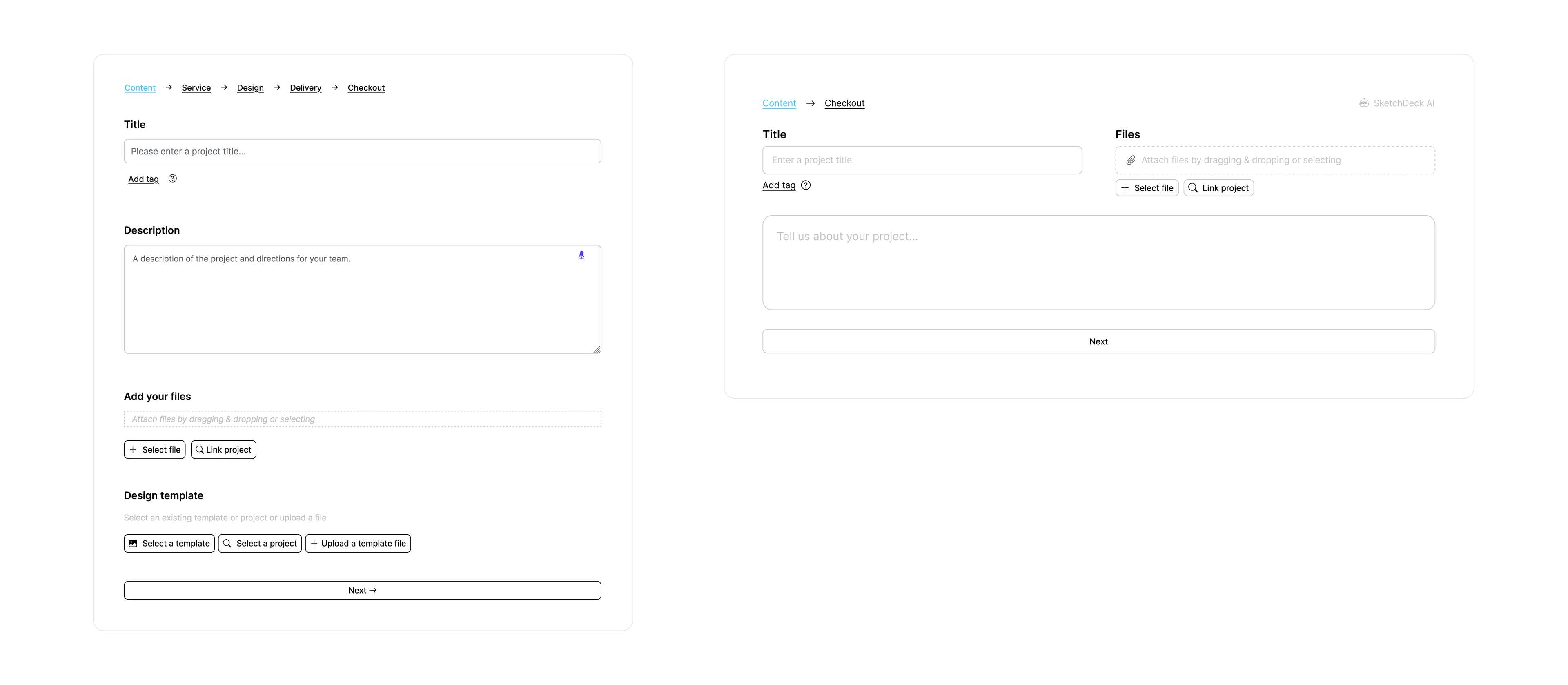
Comparing the first screen the customer would see to the AI version customers see now
Testing by building-lite: Creating a beta AI environment
We started by building a beta site to test the theory and see if we could use the AI. We wanted it to be simple with a single input so we could release the build quickly. The point was testing, not a full feature.
What emerged was incredibly simple UI: users could say what kind of project they need, and the AI would input info and give likely options. Yes, the UI was confusing (users had one field and no guidance through the flow) but that was not the point. The point was to see if users could complete the process, how long it took, and if the completion rate for started projects went up.
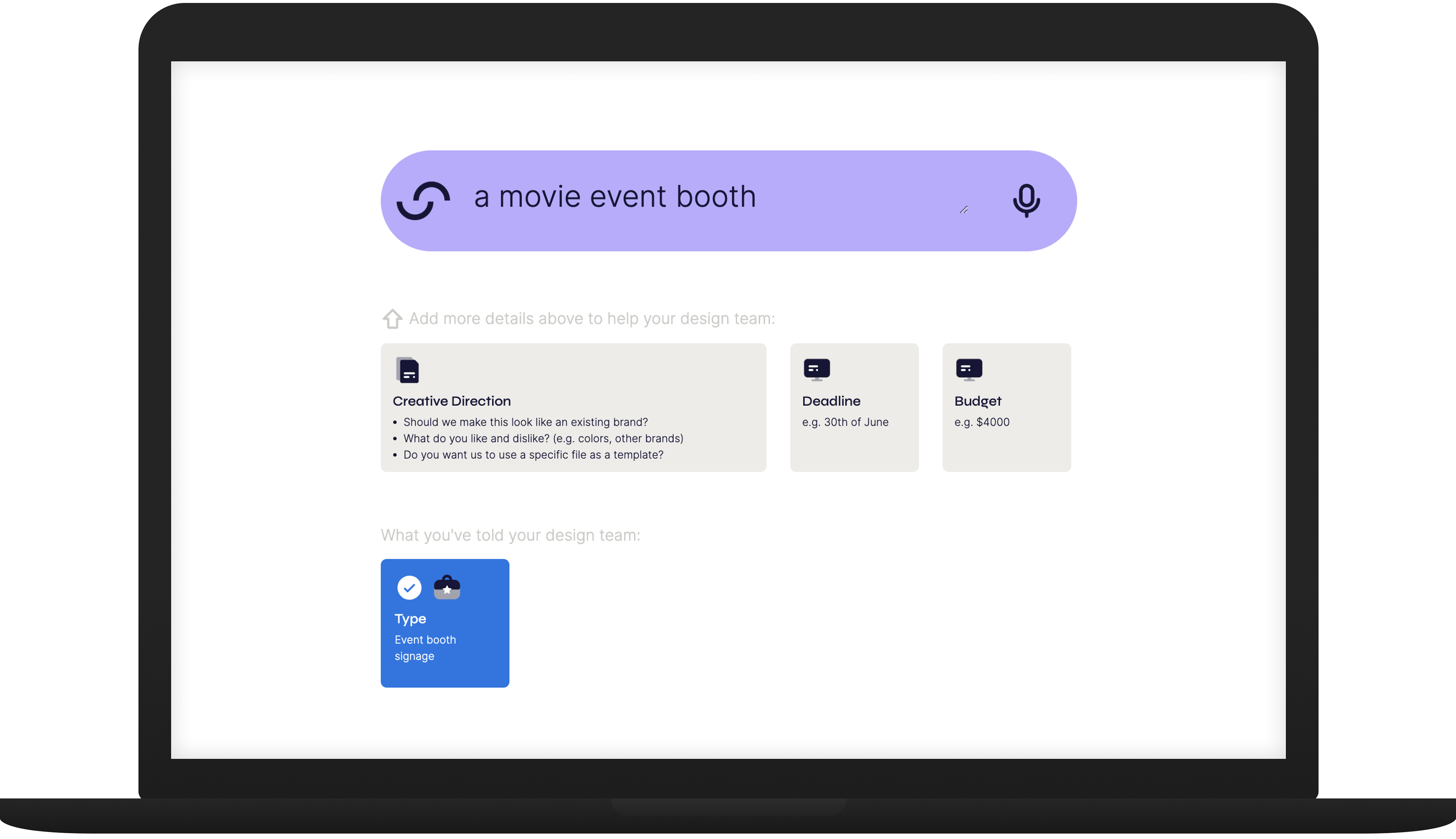
AI brief in beta
Validating the hypothesis: what was the project brief completion rate
We launched a live beta site and looked at metrics to see completion rate. We did not promote the AI site but it was an option on the project intake form. In tandem, we worked with PMs to get their feedback on the old brief while having them open up the brief to clients. The initial UI proved much too difficult to interact with.
We broke up the customers into 5 user groups, ranging from a new customer from a new account to a seasoned customer from a prolific account. While the initial AI intake form worked, we took the simplicity of AI and combined it with the knowledge of the project brief.
What resulted was a simple intake that walked clients through their project, asking them necessary information while showing them the progress. Users were able to fill out the form and choose what information they wanted to add.
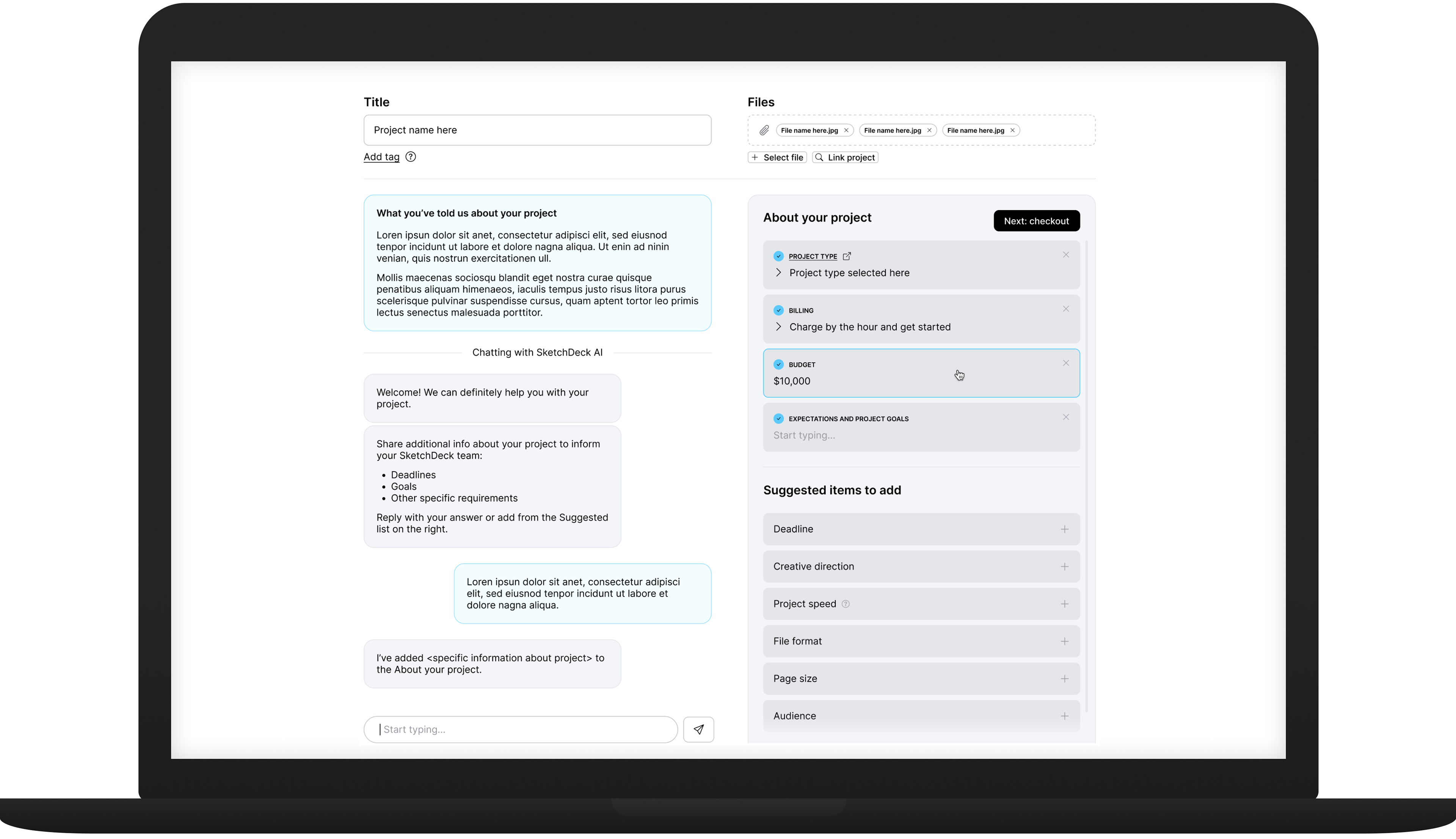
A chat prompts the user while also guiding the user to fill out the brief. Each side mirrors the information and caters to both newer users and power users.
The outcome: the intake form was reduced from 5 phases to a single form, only asking clients necessary information about their project. While time spent on the form was similar, the design teams had much more usable information and were able to start on projects faster, without having to set up kickoff meetings with the clients.
The AI drew from past projects in the client's organization as well as from similar projects to ask for information. The additional advantage was that clients felt like they had a partner at the start of a project. For new clients, this was a huge improvement and indicator for the great partnership they could expect when working with their project teams.
While time spent on the forms was similar, users had a more engaged process. They didn't spend time going through the form and useless information, so their time felt more valuable and better spent.